
Broken Arrow Mold Remediation
When water intrusion threatens structural framing, prompt containment stops fungal colonies from spreading through living spaces. Our region's sustained summer humidity accelerates active mold colonization inside unconditioned crawlspaces and damp wall cavities within 24 to 48 hours of a moisture intrusion event. A pattern echoed in trade discussions notes that in Oklahoma's humid summer climate, wet drywall paper and insulation become active mold breeding grounds within 48 hours unless extracted within the critical 60-minute emergency response window.
Call (918) 555-0171 once the source is off. If you can't find the shutoff, we'll walk you to it on the phone.
Precision Remediation And Moisture Control
Our technicians specialize in isolating microbial growth and eliminating root moisture sources before structural framing sustains permanent rot.
The median owner-occupied home in our community was built in 1993 according to Census ACS 5-year estimates, meaning aging plumbing lines frequently create hidden cavity leaks.
Our regional coverage supports 44,834 housing units on record in the Census ACS 5-year estimates across both newer subdivisions and established neighborhoods.
About 38% of housing units locally (16,875 of 44,834) were built since 2000, so a substantial share of the local stock is still on its original systems.
Homeowners question contractor integrity when referred restoration technicians immediately push for aggressive wall demolition and commercial dehumidification for minor leaks.
We counter that industry trend by performing calibrated non-destructive pin and acoustic meter inspections before cutting any drywall.
When moisture penetrates deep framing, you can schedule immediate emergency water damage extraction to halt structural saturation before secondary decay takes hold.
Every protocol we follow aligns with rigorous ANSI and IICRC standards to guarantee clean clearance verification.
Our Four-Stage Remediation Protocol
Property owners dealing with hidden moisture and mold contamination lack clarity on the required stages, containment protocols, and repair timelines, which is why our technicians establish transparent documentation from initial thermal imaging to final clearance testing.
- Moisture Mapping & Source Discovery. Technicians track moisture boundaries using infrared thermography and deep-probe meters to identify plumbing leaks or ground seepage without unnecessary demolition.
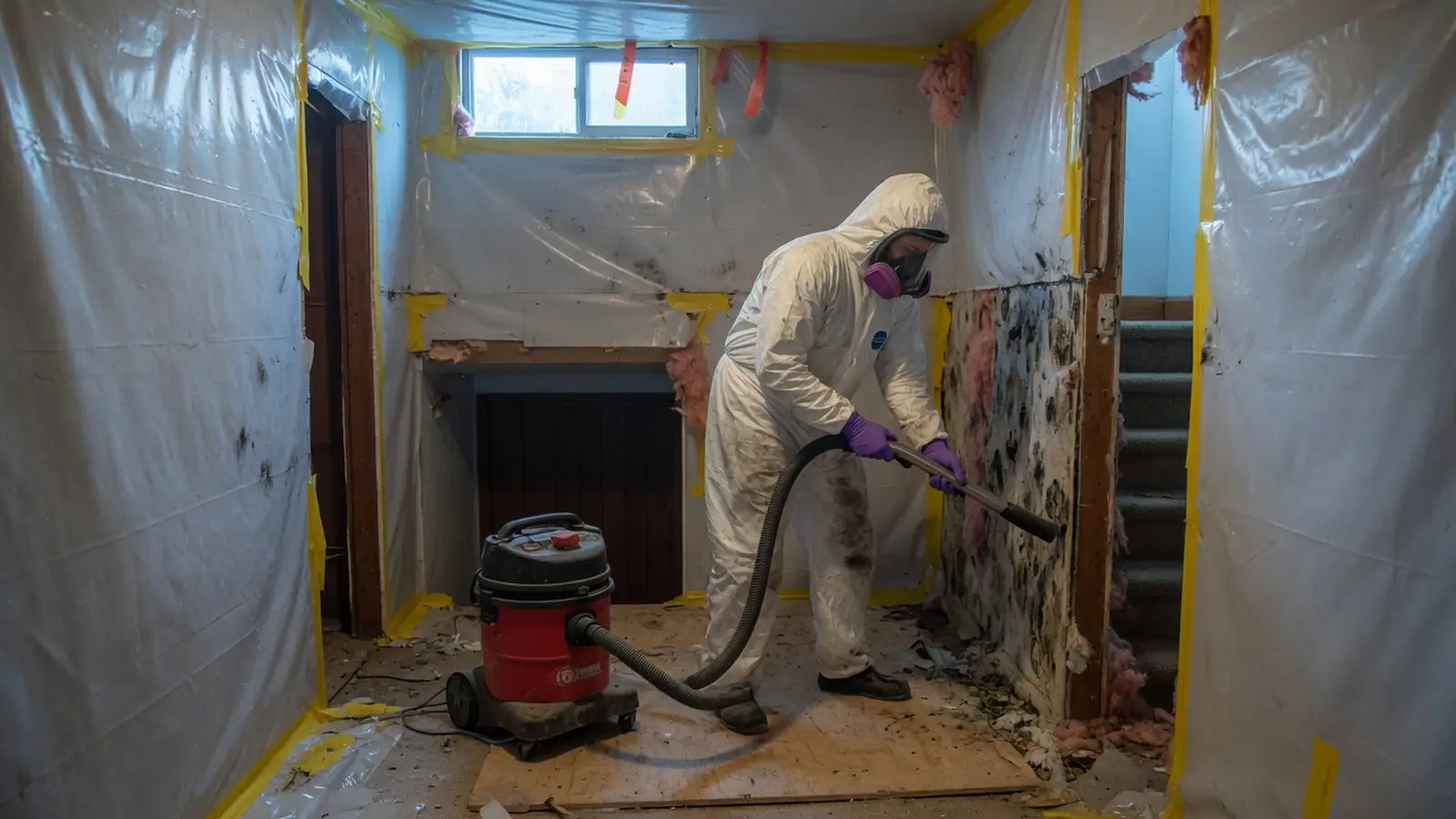
- Negative Pressure Containment. Certified mold remediation requires establishing 6-mil polyethylene containment zones under negative pressure to prevent disturbed fungal spores from entering active HVAC return ducts.
- HEPA Filtration & Remediation. Our specialists scrub airborne particulate using commercial HEPA air scrubbers while applying EPA-registered antimicrobial treatments and precision HEPA vacuuming to framing.
- Psychrometric Drying & Clearance. Insurers routinely deny claims for lingering moisture without daily psychrometric logs and thermal imaging proving structural framing was restored to local baseline moisture levels.
Documented Clearance Verification
When rising surface runoff or drainage overflows contaminate lower levels, our technicians apply professional protocols for comprehensive flood cleanup services to eliminate biohazard threats before treatment begins. Homeowners troubleshooting recurrent crawlspace water pooling struggle to determine whether sump pump replacement or exterior discharge adjustments will resolve the issue, so we evaluate grading alongside subfloor moisture dynamics. We stand behind our remediation with third-party laboratory air clearance verification, ensuring spore counts drop to or below outdoor background levels before containment walls are taken down.
Thermal Moisture Detection
We map moisture migration paths behind sheetrock and under subfloors using calibrated infrared cameras and non-penetrating meters. This precision discovery locates saturated pockets without blind demolition.
Crawlspace Decontamination
Our crew eliminates fungus from subfloor joists and installs heavy-duty ground vapor barriers to halt subterranean humidity migration. For exterior roof or window breaches, review our emergency response for severe storm damage recovery to protect building envelopes.
Structural Antimicrobial Treatment
Our technicians apply hospital-grade botanical biocides to bare framing after HEPA vacuuming and controlled agitation. This non-toxic treatment penetrates wood grain to stop fungal hyphae from recolonizing.
Our Commitment To Quality Remediation
Our focus remains on honest diagnostics, verified physical containment, and scientific drying logs. We hold technicians to rigorous industry standards so every property owner receives safe, transparent, and permanent restoration.
- 10Zip Codes Served
- 4Service Areas
- 3Services Offered
Here is how local property owners describe their experience with our prompt moisture containment, transparent quotes, and clean remediation results.
“The upfront written estimate was completely transparent from our first call, with itemized line items for every piece of air filtration equipment. When the final invoice arrived after clearance testing, every single cost matched the original quote with zero surprise change-orders. The crew explained the scope clearly and kept their word on the budget.”
Marcus T.
“Watching their precision sealing airtight 6-mil plastic barriers around our hallway doorway made me confident nothing would escape into our living room. Every seam along the baseboard was taped flush and perfectly smooth, leaving the framing completely clean and sanded down to bare wood. The team treated our home with incredible craftsmanship and meticulous care.”
Elena R.
“I already gave their contact details to my next-door neighbor when she noticed damp spots spreading across her laundry room baseboards. After seeing how quickly this company halted the spore spread behind our vanity and validated air quality, I knew she would be in safe hands. They earned my full trust and repeat recommendations.”
David K.
“During the subfloor containment inspection, the crew uncovered a hidden slow pinhole pipe drip behind the insulated partition that had rotted the bottom plate. Instead of panicking or halting work, the team immediately isolated the line, documented the moisture baseline, and adjusted the containment without any drama. Their calm professionalism turned an unexpected complication into a painless fix.”
Sarah M.
Frequently Asked Questions
Does spraying household chlorine bleach onto wood wall studs and sheetrock eradicate active mold colonies or only bleach their color?
Spraying household chlorine bleach onto wood wall studs and sheetrock only bleaches their color rather than eradicating active deep fungal roots. Chlorine bleach cannot penetrate porous wood and drywall surfaces, leaving the underlying mycelium intact while introducing excess water that accelerates regrowth.
How long does a professional mold remediation project typically take from start to finish?
Professional mold remediation projects typically take between one and five business days depending on moisture depth and containment zone sizes. The duration includes establishing negative pressure containment, physical removal of unsalvageable materials, HEPA air scrubbing, and post-remediation clearance verification.
Why is negative air containment necessary during microbial remediation?
Negative air containment prevents disturbed microbial spores from circulating into living spaces and active HVAC systems during physical removal. Continuous negative pressure draws air into the sealed 6-mil polyethylene barrier through HEPA filtration units that exhaust scrubbed air outdoors.
Will homeowners insurance cover mold cleanup costs caused by plumbing leaks?
Insurance coverage usually applies to sudden and accidental pipe bursts when supported by prompt thermal imaging and certified psychrometric logs. Gradual leaks or neglected maintenance issues are typically excluded by adjusters, making comprehensive moisture documentation critical for claim approval.
How do technicians verify that indoor air quality is safe following remediation?
Technicians verify indoor safety by conducting independent post-remediation clearance testing and baseline comparative air cassette sampling. Third-party laboratory analysis confirms airborne spore concentrations and species distributions inside the containment match or improve upon exterior baseline levels.